On November 14, 2018, the European Parliament, approved the obligation for all countries of the European Union to provide a population alert system in case of emergency situations. Legislation does not determine whether it will be used or Cell Broadcast or SMS to alert citizens. It will be up to each country to decide what kind of technology to use. In Portugal it has not yet been decided what is the best system to implement to alert the population and visitors. Currently, Civil Protection is authorized to send alerts by SMS, and only in case of fires, and it is foreseen the approval of a decree law that allows Civil Protection, and the City Councils, to send SMS in case of risk to public health, serious accidents, or natural disasters.
INTERNATIONAL CONTEXT
Several countries have implemented systems to send alerts to the population using Cell Broadcast, such as the United States, Chile, Japan, the Netherlands, Romania, Lithuania, Canada, South Korea, New Zealand, Thailand, the Philippines, among many others. Other countries have opted to implement a system using location-based SMS, such as Australia and Belgium.
SMS vs CELL BROADCAST
Advantages and Disadvantages
For a quick and effective communication with the population and visitors the ideal is to use the Cell Broadcast, It operates on 2G, 3G and 4G networks and is standardised for 5G. Hence the choice of many countries, where it is implemented, to send Alerts. The time elapsed since the sending of the Alert by the entities to one or more defined geographical areas and the receipt of this message is approximately 4 seconds on all equipment. Messages sent using Cell Broadcast are not delayed in delivery, even if there is saturation in data, voice and sms services in a certain geographical area. An alert can be sent to thousands of users without any degradation in the service. In the case of SMS, when sending thousands of bulk SMS there are delays in delivery that can be up to or more than 3 hours after sending. Recently this situation happened in the Philippines, where the population that received the alert by Cell Broadcast received it a few seconds later, and who received the alert by SMS received it with a delay of 3 hours. With Cell Broadcast standardization, alerts can be received in any country that has adopted this system, if we travel to the Netherlands or the United States, and if an alert is sent, it will be received on the equipment. Alerts are received in a certain geographical area selected by the competent authorities, the message is displayed on the screen of the equipment, followed by vibration, audible alert and voice reading. The message may be written in more than one language. In Canada they send the alerts in French and English. In Romania and the Netherlands, they allow Cell Broadcast channels to be set up manually on older devices so that they can receive alerts. In Portugal only the mobile operator altice MEO has Cell Broadcast active throughout its 2G network. Customers and visitors who have equipment configured in Channel 50, receive the information of the code and Region where they are at the moment, for example "21 Lisbon". As Cell Broadcast messages work like broadcasts from AM or FM radio stations, any user who is in the geographical area defined for sending the alert receives the messages anonymously, the operator is not aware of who received the messages. You can disable the reception of Cell Broadcast messages on your devices. In the United States, Canada and New Zealand it is not possible to deactivate alerts on equipment by government decision.
MAIN DEBANTAGES OF CELL BROADCAST
The initial investment
Compatibility of equipment on the market: for example, in the case of iPhones, it would be necessary to ask Apple for a software update, and in the case of other devices, manual configuration by users would be required.
The advantage of SMS over Cell Broadcast is that all devices support the reception of SMS, at an early stage it would allow to reach almost 100% of users.
MAIN DISCONTINUEMENTS OF THE SMS SYSTEM
Delay in messages that can take hours to reach users, there are practical examples of this where recently in the Philippines SMS took 3 hours to be delivered to the Population. In Portugal we also see delays in the delivery of SMS because they will always be dependent on various factors such as the capacity and saturation of the network in certain places.
Unable to opt-out.
Fake SMS can be sent on behalf of an entity, at the risk of creating panic in the population.
Privacy issues: there is an LBS database recording the locations of subscribers and visitors.
A possible obstacle to the implementation of Cell Broadcast in Portugal for a warning and warning system to the population may be the financial factor. SMS is widespread, in Cell Broadcast there would have to be investment. On the part of mobile operators there is no business model where they can have a financial return with Cell Broadcast. In all countries where it was implemented there had to be a political decision and investment by the Government.
SMS versus CELL BROADCAST
Features
SMS
CELL BROADCAST
Transmission type
Sent point-to-point messages
Messages sent on-to-many
Dependence on mobile phone number
YES – requires maintenance of a database with telephone numbers registered on the network
NO – Does not require the maintenance of a database containing the numbers recorded on the network
Subject to network congestion
Subject to delivery delays or failures when sending a large number of SMS
Messages are sent on dedicated channels, with no delays in delivery when the mobile network is congested.
Repetition
No repetition
Messages may be transmitted and repeated in a time interval between 2 seconds and 32 minutes.
Message size
140 to 160 characters. A maximum of 5 messages can be concatenated
93 characters. Maximum 15 pages can be concatenated
Message Type
Static messages are sent to all numbers registered on the network
Custom messages can be sent to different geographic areas to reflect different alert states or hazards
Notification and presentation of the message
The reception and presentation of the message will be the same as that of an SMS with the type of touch customized by the user
A message is displayed on the screen accompanied by an audible signal, vibration and voice reading
Compatibility
Compatible with all commercialized equipment
Compatible with most equipment on the market, it may require manual configuration or a software update by the manufacturer. The presentation of the Configuration Menu may be different between devices
Receipt
The message is received as soon as the equipment registers on the network
No message is received if during transmission the equipment is switched off. When connected if there is still transmission of messages they will be received
Delivery Confirmation
YES – The sender may request confirmation of delivery
NO – Message delivery confirmation is not possible
Language selection
NO – Same for all addressees
YES – Messages may be transmitted in several languages, the receiver being able to choose the desired language
Message Security and Integrity
FRACA – the message can be forged by third parties
STRONG -Only the carrier can transmit the messages
roaming
Visitor depends on home network for routing messages
Message delivered to all equipment that is registered in a given cell
HOW DOES ALL THIS WORK?
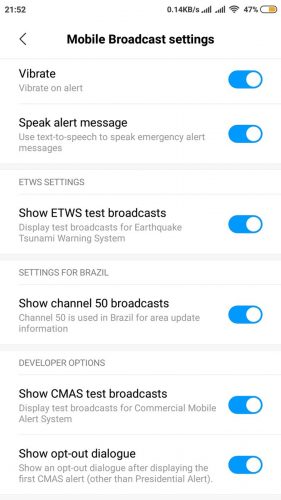
Above we can see the configuration menu for the via alert system CELL BROADCAST SYSTEM
In the images below two examples of alerts via CELL BROADCAST SYSTEM in Romania
WHAT IS A CELL BROADCAST SYSTEM?
A Cell Broadcast System consists of a Cell Broadcast Center (CBC) located on a mobile operator's network. There may be one or more Cell Broadcast Entities (CBE), depending on the entities that will generate the messages. CBEs are available in different types and can be provided as a simple terminal or as an application. Whatever configuration the entities choose, the complexity of the mobile network service remains hidden by the CBC, making the Cell Broadcast service simple to use. Through the CBE, entities simply create a message and select the location(s) to which they need to send the message, using an intuitive user interface. The message is then sent to the CBC that maps the target area to the mobile network cells. Subsequently, the CBC sends the message to the required radio access network elements that manage the transmission of the message in the cells of the chosen geographic area.
Architecture of a Cell Broadcast System
SMS - Messages sent point-to-point
CBS - Messages sent one-to.many
Category: New Zealand CBS architecture
CONCLUSIONS
With the European Parliament's approval of the obligation for all countries of the European Union to provide a population alert system, we believe it is time that we all, as active citizens and stakeholders, had an open and not only technical discussion on what solution to adopt in our country. At VOST Portugal we are of the opinion that the best solution is the one that will quickly send the alerts to the largest number of people in the affected areas. We have a variety of examples, unfortunately, where a CBS could have prevented human and material losses, and there is now a unique opportunity to implement a solution that serves populations. We leave here some questions, which seem relevant to this discussion:
What bodies are being consulted in order to have legislation that serves citizens?
What are the mobile communication technologies to be considered to inform the population?
As the topic is complex, what additional initiatives are planned to ensure a discussion involving all citizens?




 English
Pingback: Cell Broadcast Portugal – Public Warning System (PWS) – Blog Ricardo José Saraiva
Comments are closed.